

Learn How to Grow Beautiful Tulips
Tulip Culture Guide:
Questions & Answers
Expert advice on planting, soil, fertilizing, watering, and more — drawn from decades of experience growing tulips across North America.
New to tulips? Shop our Tulip Collection →
This guide draws on the knowledge and experience of Brent and Becky Heath, nationally recognized gardening experts and passionate advocates for successful gardening. As owners of Brent and Becky's Bulbs, they have spent decades helping gardeners across North America grow and enjoy flowering bulbs.
Brent travels throughout the United States giving lectures and sharing his expertise, as well as leading the popular Living Flower Arrangements Workshop, where participants are introduced to the wonderful world of container gardening with flower bulbs.
Below are answers to some of the most frequently asked questions to help you successfully grow and enjoy tulips in your garden.
📖 This guide is adapted from Tulips for North American Gardens by Brent and Becky Heath. Shop our full tulip bulb collection →
1
Planning Your Tulip Garden
When should tulip bulbs be planted?
Planting time in the fall varies according to climate. Generally speaking, planting should not occur until the soil temperature in your area is 60°F or less at 6–12 inches deep. This is usually after the first heavy frost, but four to five weeks before the soil freezes solid.
A bulb may be stressed if planted in soil that is too warm and damp. On the other hand, bulbs need time to form roots before the ground freezes. Once roots are initiated, the bulb's cellular walls join, becoming more elastic and resistant to freezing.
| Hardiness Zones | Recommended Planting Window |
|---|---|
| Zones 2–3 | Earlier in fall is fine |
| Zones 4–7 | October through November |
| Zones 8–*9 | December or January |
| Zone 9+ | Pre-cool bulbs, or purchase pre-cooled |
*Because spring flowering bulbs need to experience winter temperatures in order to bloom, it is probably best to pre-cool in zone 9 or buy pre-cooled bulbs.
Why is it important not to plant tulip bulbs too early?
Many believe that the garden center displaying the first bulbs wins more sales. This sometimes happens as early as Labor Day, when temperatures can still reach 90°F or higher in many parts of the country and the ground temperature is simply too hot for planting.
⚠ Important: A bulb may be stressed if planted in soil that is too warm and damp at the same time.
How should tulip bulbs be stored if purchased early?
If you take them home early, keep them dry, in a cool, well-ventilated area between 50–70°F. If you have any doubts, place a fan nearby — there is no such thing as too much ventilation.
Keeping bulbs dry helps eliminate the danger of fungus-related diseases.
How long do tulip flowers typically last?
Most individual tulip flowers last two to four weeks. Their duration depends largely on the temperature during bloom time. Flowers also tend to last longer when nighttime temperatures remain low.
If a day is very hot, dry, and windy, petals lose moisture and bloom time decreases. In general, the thicker the petals and sepals, the longer the flower lasts.
❧ ❧ ❧
2
Choosing Where to Plant Tulips
Where should tulips be planted in the garden?
First and foremost, remember that tulips prefer a sunny location.
Consider the following areas when deciding where to plant your tulip garden:
- A bank near your driveway or sidewalk where you and your neighbors will see the garden frequently
- A lamppost garden near your entranceway
- A mailbox garden you visit nearly every day
- A front-door garden that offers a friendly welcome
- A garden viewed from a kitchen window
- An island garden in the lawn that breaks up a sea of green
- A raised patio planter or portable container garden
- A window box — a living flower arrangement
- A street-side garden to greet friends and neighbors and share smiles with the community
How should tulips be arranged for the best visual effect?
Plant at least ten tulips in a group. Space bulbs three times their width apart (about 3 inches) in gardens viewed from 10–20 feet away.
If the planting will be viewed from 50–100 feet or more, you will need 50–100 bulbs in a group for a strong visual effect.
💡 Brent's Tip: Do not try to "stretch" a bag of 10 bulbs by planting them far apart. The result will be a weak and disappointing display.
❧ ❧ ❧
3
Soil & Site Preparation
What type of soil do tulips prefer?
Tulips perform best in neutral to alkaline soil. If you do not know your soil's pH, you may want to contact your county extension agent about soil testing.
Tulips also prefer fertile, well-drained sandy loam soil with plenty of compost, especially at the root level.
What should gardeners do if their soil is not ideal?
Few gardeners have ideal soil. Do not despair.
In most situations, soil can be improved by adding compost, except in extremely wet soils where drainage must first be corrected.
Why is drainage important for tulips?
Tulips need to be dry during the summer months when they are dormant.
If soil retains moisture from summer thunderstorms or excessive irrigation, bulbs may become stressed when wet and hot and develop fungal diseases that cause rot.
What can be done if soil is poorly drained or heavy clay?
Where heavy clay or poorly drained soil exists, deep planting can be difficult and stressful for bulbs.
One solution is to improve the top layer with compost, plant bulbs in the improved soil, and berm additional soil or sand over them to create a raised bed. This improves drainage while still providing sufficient depth.
❧ ❧ ❧
4
Organic Soil Amendments
How can heavy clay soil be improved for tulips?
Heavy clay soils should be amended with generous amounts of organic matter, including compost and pine bark fines. These materials, along with topsoil or compost, should be thoroughly incorporated several inches deep to create a blended soil structure.
💡 A Word of Caution: You might be tempted to toss in some sand to "loosen things up," but resist the urge — mixing sand with heavy clay can turn your soil into something closer to brick than garden bed!
Should organic matter be added regularly?
Yes. Adding a yearly layer of decomposed leaves or fully composted material helps maintain soil fertility.
We ask soil to give something to us every year — we should remember to give something back.
❧ ❧ ❧
5
Planting Tulip Bulbs
How should tulip bulbs be handled before planting?
Handle tulip bulbs like eggs or delicate fruit. Rough handling can bruise them, making bulbs susceptible to fungal infections that may cause rot.
How deep should tulip bulbs be planted?
The general rule is three times the height of the bulb deep and three times the width apart.
Some tulip varieties benefit from deeper planting — four times the bulb's height in good soil.
Why must gardeners plant tulips at the correct depth?
Tulip roots are non-contractile, meaning they cannot pull themselves to the proper depth. Gardeners must place bulbs at the correct depth during planting — the bulb cannot correct a planting error on its own.
Why can deeper planting benefit tulips?
Larger bulbs planted deeper (8–12 inches to the bottom) often bloom for more years because bulbs divide less readily.
Deeper planting also helps protect bulbs from voles, which usually work the top 3–4 inches of soil and rarely burrow 8–12 inches deep.
Additional soil also provides insulation, protecting bulbs from severe winter conditions and disease stress.
❧ ❧ ❧
6
Tools for Planting Tulips
What tools can be used to plant tulip bulbs?
Many types of tools are available for planting tulip bulbs.
A long-handled trowel can easily dig a 6"–8" hole. A 3" × 12" auger on a portable drill can easily and efficiently dig holes 6"–8" deep in most soils — this is the tool Brent and Becky use to plant bulbs in their own gardens.
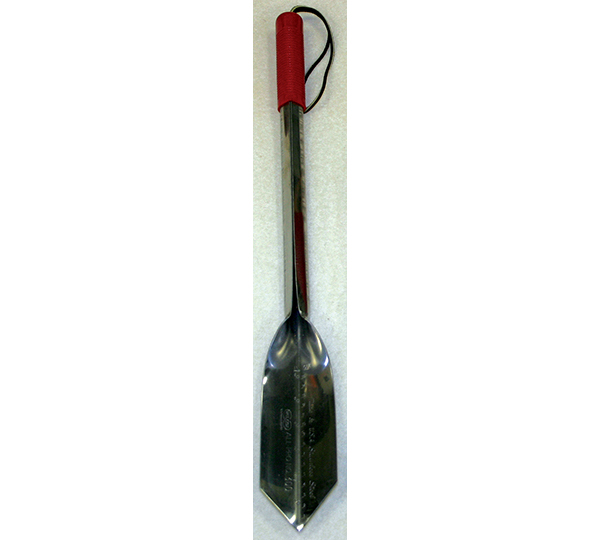
22″ (A) Stainless Steel Trowel
Very sturdy and long handled, this trowel can be used for any number of projects (planting, transplanting, digging) – it even makes a terrific ‘pooper scooper’! Also large enough to plant larger bulbs; 2 3/4” wide blade.
Shop 22″ Stainless Steel TrowelWhat tools work best in prepared soil?
Most cone-shaped tools, whether hand-held or foot-powered, light-weight or heavy-duty, are designed to be used in soil that has been well-prepared or tilled and is relatively free from roots or rocks.
What tools work well in unprepared soil?
Narrow 2"-wide spade-like implements can be used in unprepared soil, around the base of trees, and in ground covers.
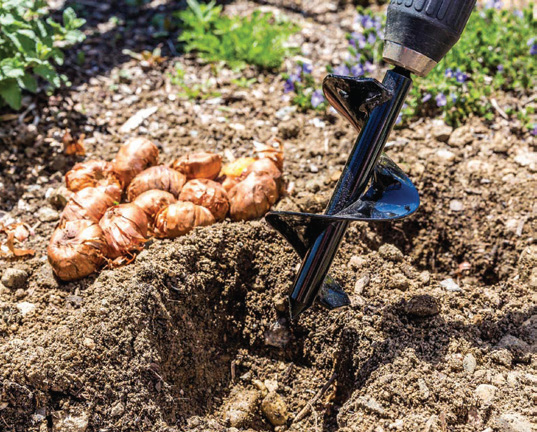
Power Planter Auger
Our Power Planter auger comes in two sizes and can be used for planting bulbs, tilling planter boxes, planting vegetables, and much more!
Shop Power PlanterCan a trowel be used to plant tulips?
A 2" × 9" stainless steel trowel is another favorite tool for planting tulip bulbs.
Hold the trowel like a dagger, stab it into well-worked soil, pull the handle toward you, and place the bulb into the hole created behind the blade.
❧ ❧ ❧
7
Watering Tulips
When should tulips be watered?
There are two important times when watering tulips is essential for producing beautiful flowers in future seasons:
- Right after planting in the fall — the root system needs significant moisture to begin forming before winter.
- In the spring — when the plant begins to sprout and push through the soil. Watering should continue until the foliage begins to turn yellow.
How much water do tulips need?
Tulip bulbs need about ½ inch of rain or water per week for optimum growth.
If they receive less, the plants may not reach their maximum height, and the flowers may not achieve their full potential.
Why should overhead watering be avoided?
Too much water on the leaves and flowers during warm spring days and nights can make tulips more susceptible to botrytis, a very damaging leaf fungus.
❧ ❧ ❧
8
Mulching Tulips
Why is mulch beneficial?
Almost all gardens benefit from mulching. Mulch helps the soil retain moisture, controls fluctuations in soil temperature, reduces weed germination, and adds important organic matter to the soil.
What mulch is recommended?
Our preferred mulch is pine needles, often called pine straw or pine tags.
This material provides a lightweight blanket that breaks down into organic matter yet does not easily blow away.
Wood chip mulch aged for one year is also an excellent choice.
When should mulch be avoided?
If you have seen signs of voles, mulch can become their invitation to a snug winter haven where tulip bulbs will be the feast.
In this case, you may want to wait until early spring to mulch, just as early bulbs begin to break the surface of the soil.
You may also consider using Plantskydd, an organic product that helps keep critters away.
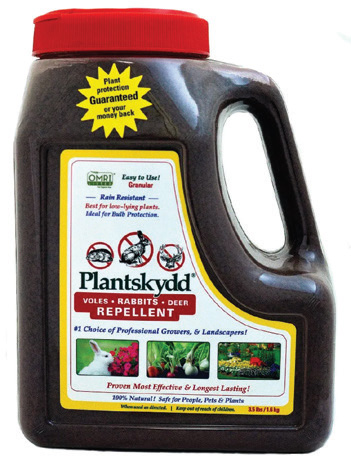
Plantskydd — Organic Critter Repellent
An organic product that helps keep voles, deer, and other critters away from your bulb garden.
Shop Plantskydd❧ ❧ ❧
9
Fertilizing Tulips
Are tulips heavy feeders?
Yes — tulips are heavy feeders. .
When do tulips take up nutrients?
According to extensive study, when tulip bulbs initiate roots in the fall after planting, they begin to feed heavily. They continue feeding during the winter unless the ground is frozen, then resume heavy feeding in early spring.
Their nutritional intake continues until the foliage turns yellow.
When should tulips be fertilized?
Since fertilizer must be at the root level in order to be absorbed, and it takes time to reach that level in the soil, we recommend adding Espoma Organic Bulb-Tone in the soil with the bulbs in the fall after planting.
Please follow the label directions.
Why should fertilizer not be placed directly in the planting hole?
A bulb already has everything it needs stored within it. When its roots emerge, they are brand new and extremely fragile.
If they come into contact with fertilizer at this stage, the roots may burn, and the bulb may struggle to remain healthy. Fertilizer placed directly in the planting hole causes the demise of many bulbs.
We recommend adding Espoma Organic Bulb-Tone to the soil with bulbs in the fall after planting. Please follow label directions.
Why is slow-release fertilizer recommended?
Slow-release fertilizer releases nutrients gradually as soil microbes break down natural ingredients, providing balanced nutrition throughout the tulip's growth cycle.
Because of this, organic slow-release fertilizers are much less likely to burn roots or bulbs than synthetic fertilizers, which often leach into the water column and into our waterways, creating pollution.
Why is bone meal not recommended?
We are often asked why we do not recommend bone meal.
In our over-processed world, bone meal simply is not what it once was. At best, it provides only phosphorus with a few trace elements. It lacks adequate nitrogen and potash, making it nutritionally unbalanced.
Bone meal also tends to attract rodents and dogs, which may dig up bulbs after smelling it.
What organic fertilizer can be used for tulips?
If you prefer an organic approach, we recommend Espoma Organic Bulb-Tone.
It contains natural organic ingredients such as bone meal, feather meal, poultry manure, alfalfa meal, and greensand, along with beneficial microbes that help break down nutrients in the soil. These ingredients help bulbs develop strong roots and produce good flowers.
Azomite, while not a traditional fertilizer, is a natural mineral soil improver that supplies trace elements. It helps plants perform better with more blooms with better color, improved fruit set, fewer pest problems, better-tasting fruits and vegetables, and greener, more drought-resistant lawns.
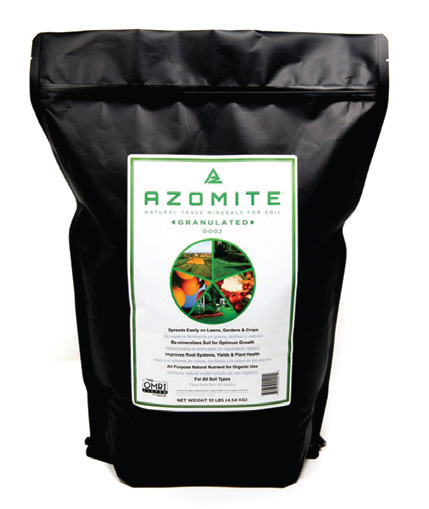
Azomite — Natural Mineral Soil Improver
A natural volcanic mineral product supplying over 70 trace elements. Improve bloom count, color intensity, and overall plant vigor.
Shop Azomite❧ ❧ ❧
10
Managing Weeds
Do weeds harm tulips?
While weeds may be unsightly in the garden, they generally do not harm tulip bulbs unless they rob the plant of nutrients or water, or grow in an invasive, choking, or light-blocking manner.
What weeds commonly appear in tulip gardens?
Common weeds in our zone include chickweed, nettle, vetch, and rye grass.
Hen-bit, field cress, and wild Johnny-jump-ups, although classified as weeds, produce pretty flowers that can complement the sometimes naked-looking tulip plant.
What is "gross weeding"?
Once these weeds pass their prime in early summer, they can be easily removed in large handfuls, which Brent and Becky call "gross weeding" — the opposite of fine weeding.
How can weeds be controlled without chemicals?
Because we live right on a saltwater tributary of the Chesapeake Bay, we avoid using chemicals.
For persistent perennial weeds, we use a cut-and-paint method, where the plant is cut back and a very small amount of glyphosate is carefully applied to the freshly cut stem.
This targeted approach controls difficult weeds while minimizing impact on surrounding soil and plants.
We have developed a garden design philosophy.
💡 "If you put enough plant material in the garden, there is less room for weeds."
Careful companion planting, mulch, and judicious weeding at the right time help create an environmentally friendly and beautiful garden
❧ ❧ ❧
11
Deadheading Blooms & Maturing Foliage
Why should fading tulip blooms be removed?
If you want beautiful flowers year after year, it is important to snap off fading blooms and immature seed pods.
Otherwise, more than one-third of the bulb's energy will go toward producing seeds rather than returning to the bulb as starches and sugars for next year's bloom.
How long should tulip foliage remain after blooming?
It is equally important to allow leaves to remain intact until maturity, when the foliage begins to turn yellow and flop over.
At that point the leaves have completed photosynthesis and can be safely removed without depriving the bulb of nutrients.
This process usually takes eight to ten weeks after flowering, depending on climatic conditions.
Why should fallen petals and foliage be removed?
For disease prevention, it is important to remove fallen flowers and flopping foliage from the garden..
❧ ❧ ❧
12
Digging & Storing Tulip Bulbs
Do tulips need to be dug every year?
Tulips do not need to be dug and divided annually, as some garden books suggest.
However, in areas with wet summer soil, bulbs should be dug and stored in a warm, dry place.
When should tulip bulbs be dug?
If bulbs must be dug — whether to prevent rotting during wet summers, moving them to another location, or rearranging plantings — it is best done as the foliage turns yellow but before it disappears completely.
If the bulbs are dug, store them in a warm, dry place and replant in the fall when soil temperatures drop below 60°F.
How should bulbs be handled when digging?
Hold the foliage with one hand and insert a digging fork or spade 4–6 inches away from the bulb. Dig straight down 8–10 inches deep, then pull back on the handle to loosen the bulb and surrounding soil.
This allows the bulb to slip out without breaking away from the stem and leaves.
Handle bulbs gently to avoid damage and shake off excess soil.
How should tulip bulbs be stored?
If storing bulbs until fall, place them loosely in mesh bags or on screen-wire trays, out of direct sunlight, in a dry area with good air circulation.
We prefer to use a fan to dry them quickly. Air movement is very important to prevent stale air.
⚠ Do not refrigerate or cool bulbs at this stage. They still need warmth (50–70°F) to help develop future flower buds. Keep bulbs away from ripening fruit or decaying vegetation, which may release ethylene gas that can cause bulbs to abort next spring's bloom.
❧ ❧ ❧
13
Replanting Tulip Bulbs
How should tulip bulbs be replanted?
In the fall, planting instructions are similar for bulbs that were just dug and those that were stored through summer.
First, gently shake or rub off remaining soil. If bulbs are physically attached bulb-to-bulb, do not force them apart. Like parent and child, they will separate when the time is right.
However, gently untangle any intertwined roots.
A good rule of thumb: plant standard bulbs about three times their height deep and go a little deeper — around four times the height — for larger bulbs.
- Small young bulbs the size of nickels or dimes → plant slightly shallower until they mature
- Bulbs the size of quarters or fifty-cent pieces → plant at full depth
Ready to Grow Beautiful Tulips?
Browse our full selection of tulip bulbs — from classic single varieties to dramatic parrots and fringed types — all expertly grown and shipped at the right time for your zone.
Shop Tulip Bulbs More Growing Guides