


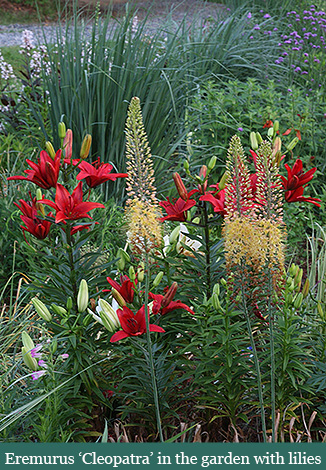
Eremurus, nicknamed ‘desert candles’ or ‘foxtail lily’, doesn’t grow from a bulb like a daffodil or tulip. It grows from a tuberous root that resembles an octopus. Some can be quite large, so fortunately, when planting them, they only have to be covered with about 3” of soil.
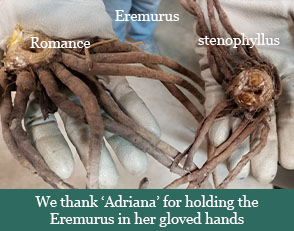

Their tubers tend to be brittle, so please handle with care. They show up best when planted with a darker background. Each 3’ – 5’ spike is covered with tons of starry florets, which are very eye-catching.
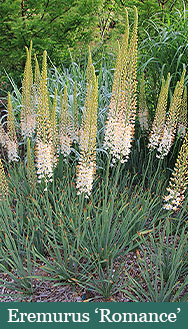
Eremurus require extremely well-drained soil and full sun. We have had a few repeat bloom for 5 – 10 years in our cut flower field with little or no effort. However, during these particular years, we had a drought during the summer and all of our rows are raised up a bit – 6” or so to help with the drainage requirement. There is no irrigation in our fields and no one accidently weeds them out like sometimes happens in our gardens. Eremurus are members of the Liliaceae, so if four legged critters are a problem in your area, we’d suggest using Plantskyyd to help with that issue.
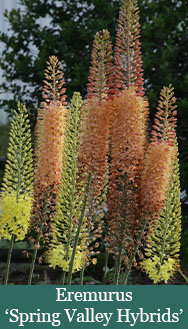
Eremurus bloom from the bottom up and it takes quite a while for them to finish blooming, so they make great, long-lasting and dramatic cut flowers!
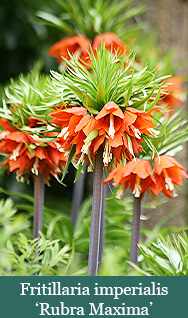
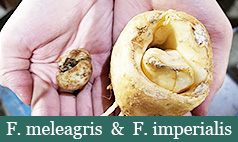
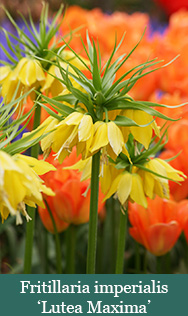
Fritillaria imperialis ‘Rubra Maxima’ and ‘Lutea Maxima’ have flowers that are incredibly eye-catching and are very site specific. They prefer rich organic but well-drained soil and are heavy feeders. They have a skunk-like fragrance, which helps them be critter resistant. As you can see in the image below, their bulbs are large in comparable to the meleagris types. Sometimes they bloom for us and sometimes they don’t – they are ‘finicky’!

We have seen Fritillaria persica blooming happily in many gardens across the US, so we are assuming that this type is less ‘finicky’. This is an Heirloom plant (1573) with stems that range from 2’-4’ tall.
They show up better in the garden when there is a contrasting color in the background, like the daffodils in this image on the left.
The hybridizers have been having a wonderful time creating new types and colors of the persica types.


One of the smaller Fritillarias and one that appears to perform better in woodland gardens, in damp meadows or Rock Gardens in some areas. When these Fritillarias meleagris are planted where they are happy and where they can remain undisturbed to ‘do their own thing’, they can be quite wonderful.

It is so exciting when we find that some of our Fritillarias and Eremurus are happy and blooming! We always try to plant them in the right place. Sometimes the weather can vary, making the perfect spot ‘not so perfect’ after all! And other times, we just don’t know why they aren’t happy. If you are a new gardener or even if you are an experienced one but have never tried growing these bulbs and want to, we suggest trying only one or two just to test. They don’t grow everywhere. Perhaps you will find the secret and you can share it with all of us!
Take a look at our fall-planting catalogue to see what we have available now!