

We are so lucky that lilies are available to be purchased and planted in the fall and in the spring and no matter which season you plant them, they will bloom the following summer. There are so many types and colors from which to choose, we feel sure you will find something that you’ll want for your garden either now or in the spring. Normally, Asiatic lilies bloom before the other types – for us, this means we have lilies blooming in June.

L.’Netty’s Pride’, on the left, and L.’Forever Susan’, on the right, are examples of this type of lily. They have many branches per bulb with multiple blooms per branch. So much color can be added to your garden with lilies.


Lilium ‘Stargazer’ is an example of an Oriental Lily, which usually blooms later in the summer than the Asiatic-types and are very fragrant. The hybridization joining different divisions of lilies has created new types of lilies that get grouped together because of their characteristics and genealogy. Below, L. ‘Black Beauty’ and L. ‘Conca d’Or’ are both ‘Oriental-Trumpet’ lilies, with parents or grandparents of each type ‘running through their veins’. The Trumpet, with tall, strong stems combined with the Oriental-types, with recurved petals and a wonderful fragrance, has brought us many fabulous lilies that make tough, terrific garden flowers and lovely, long-lasting cut flowers.

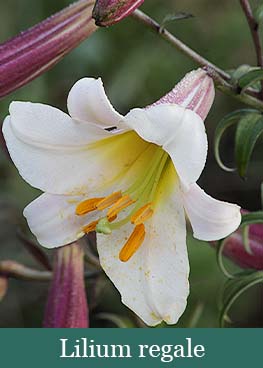
Species lilies often give the garden a feeling of a wild garden because that is basically what native lilies looked like before they began to be hybridized. The martagon-types tolerate shady areas and are doing well in one of our larger ‘Parking Lot Gardens’.

The large Magnolias that are part of that garden, protect the lilies from too much wind and I assume they also utilize much of the available moisture. But the species lilies, peek right out to say ‘hi’ to me each morning as I enter the building during their bloom time. This particular garden rarely has anyone walking through it or doing much weeding, so the lilies have not been accidently weeded out or stepped on. They have been known to reseed when they are in the happy spot. The beehives that are part of our Children’s Garden help with developing seeds of many of our visited plants, including the lilies.
Lilies benefit from being planted 8”-10” deep because not only do they have roots at the base of their bulbs, they also have roots on their underground stems, which act as ‘anchors’ that help to hold up their large, beautiful but heavy flowering heads! Most lilies perform best in full sun where they don’t have to stretch to get enough light. With the exception of the species lilies, if they have to grow in too much shade, they may get so tall, even with their stem roots, they may fall over. The two images below show the same garden at two different times during the summer. It’s obvious the impact a few lily bulbs have on the beauty of the whole garden. If four legged critters are an issue, PLANTSKYYD can keep the critters away.

Take a look at our fall-planting catalogue to see what we have available now!