


Tulip flowers have been cherished by people for centuries. There is a lot of information in books and online about a time in the early 1600’s called Tulipomania, where people exchanged huge sums of money just to have a coveted new Tulip cultivar. The love of this beautiful flower continues today, and we love them too!

Tulips are available in just about every color imaginable, except for true blue, and come in various shapes and sizes.
Gardeners use Tulips in their garden designs in many ways. Some prefer planting Tulips of one color en masse to make a statement or to create a dramatic effect.

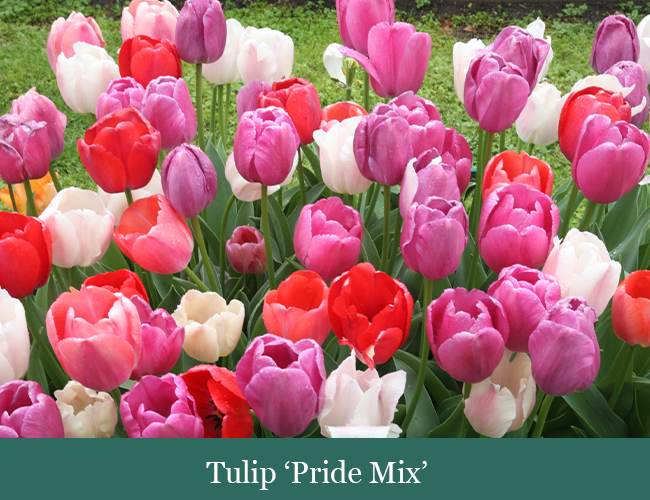
Some like to combine their favorite Tulip with a totally different flower from another genus like Tulip ‘Elegant Lady’ with Camassia leichtlinii ‘Blue Danube.’ Some like to combine their Tulips with other contrasting colors to express a statement or an eye-catching effect. Still, others love Tulip flowers so much, they don’t feel the need to know all of their names. They just prefer a fabulous mixture with lots of beautiful colors to cut for arrangements.

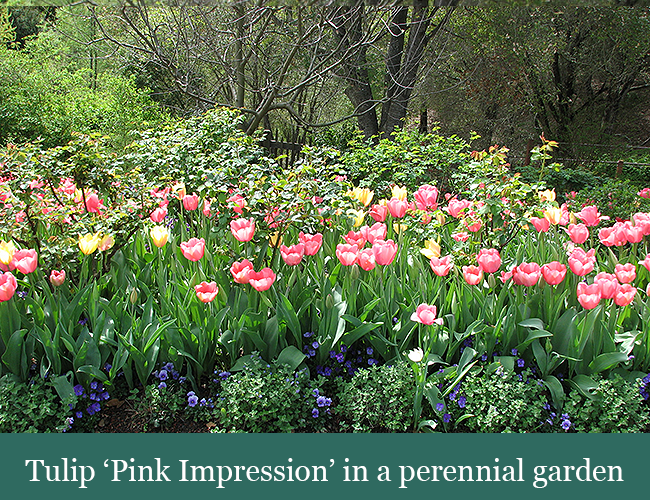
Some like to combine their Tulips with other types of flowers, creating the “perfect outfit” in the perennial garden. Below, T. ‘Pink Impression’ is the star of the show as the perennials continue to emerge, knowing that their turn for stardom is coming later in the blooming season.
Growing Tips
The main question we receive is, HOW DO YOU GROW TULIPS SUCCESSFULLY?
1. Plant them in the fall after the ground has cooled in a location with 12–16 weeks of winter.
2. Plant them 3X–4X the height of the bulb deep in well-drained soil.
3. During the summer when the Tulips are dormant (sleeping), only plant drought-tolerant annuals and perennials in the bed with the Tulips. If you normally have rain during the summer, those drought-tolerant plants will help absorb that extra moisture. Tulips like to sleep in a DRY bed—otherwise, they may rot. So, mindless irrigation is not good for Tulips!
Protecting the Tulips from Critters

Check out a product called PLANTSKYYD. It is NOT poison but it is a deterrent. We suggest getting the concentrate and follow their directions for mixing the solution.
1. Put your Tulips in a plastic bucket. Cover them with the PLANTSKYYD Concentrate solution. Using rubber gloves—only to protect your hands from the smell—take the Tulips out of the bucket and let them dry. Once dry, plant them at the proper depth in the garden. This should help with the voles, chipmunks and squirrels.
2. Take the same PLANTSKYYD Concentrate solution and spray on the Tulip plant before the buds open. This should help with the deer and rabbits.

Ready to add some beautiful spring Tulips to your garden? Order soon to get them in time for fall planting! Browse our catalogue to see all the incredible new bulbs—plus plenty of timeless classic Tulips—to add to your garden for 2023.