




If you missed the April 12th episode of Tete-aTete, Brent shared lots of answers to spring gardening questions that you can use for the fall planting season. Here’s a recap!


Jump to a Tip:
- What’s Brent’s favorite daffodil?
- Should I cut back the daffodils now or wait until they turn brown?
- Should I feed my bulbs in the spring?
- How can I keep my bulbs from rotting from too much moisture?
- What are some moisture-tolerant bulbs?
- What should I consider to plant my bulbs for sequential bloom times?
- How do you come up with the names of each bulb variety?
- What are ways to keep animals from eating my bulbs and plants?
Jay: Recorded live from the outskirts of beautiful downtown Gloucester, Virginia in the southwest corner of the second floor offices of Brent and Becky’s, you are listening to Tete-a-Tete, a podcast by Brent and Becky’s about how you can get more bang from your gardening buck. I’m Jay Hutchens and sitting alongside of me somewhere between four feet and 4000 miles apart is Brent Heath. Together we hope to share with you how you can make the world more beautiful, one garden at a time. So let’s get started right here on Tete-a-Tete. We are back.
Brent: We are happy to be here.
Jay: Do you know that it has been almost… The last podcast that we posted was on May 19th, last year.
Brent: Wow. Well, I’m happy that we are doing them again.
Jay: Yeah. You know this coronavirus thing kind of makes you look at things a little differently and you know we are used to being with… You are used to being with the customers out and about giving talks. So we’ve had to kind of create and think and go oh, yeah, videos, Facebook lives, podcast. So we are back, everybody. Welcome to Tete-a-Tete. Today’s date is April the 13th of 2020. I’ve asked some people on social media if they had any questions for you and one of the questions is, what is… This is going to be a tough one. What is the all-time best daffodil?
Brent: Wow. On which day are you speaking?
Jay: Right.
Brent: I have different bests and favorites depending on what I’m looking at. Does it have to do with length of time in bloom? If that’s the case, it would be either Ceylon, a large cup beautiful yellow strong stem, standing up to all kinds of weather like blustery winds for the day and rain or Golden Echo, one of our own hybrids. It has been in bloom now for probably six weeks.
Jay: Wow.
Brent: Well, we’ve had a lovely spring. For the most part, long and cool. Cool nights are ideal. I haven’t gotten over 80, but once or twice, so they last for a long time, but it’s one of the longest lasting in bloom and I think one of the all-time best. Jonquil, a hybrid, multi flowering sweetly fragrant, called Golden Echo because we saw the color of the corona or cup bleeding into the parents segments. And so it’s like an echo of the colors from one part to the other.
Jay: Yeah, I always say it looks like the cup is butter and it’s melting.
Brent: Yeah. That’s a good analogy.
Jay: Into those white petals.
Brent: And then the other neat thing about it is it has attractive leaves. You know some daffodils have big ugly leaves that flop over and they just ain’t real complimentary to the beautiful flower. So it’s kind of nice when you have a dark green leaf that complements. It’s attractive in the garden as well.
Jay: It is. it is indeed. I replied to Ann who asked this question on Facebook and I said that’s going to be tough like, picking your favorite child or something.
Brent: And when I met my child, the one, Ceylon was born the same year I was, so that wouldn’t be a possibility.
Jay: Yeah, it’s a classic for sure.
Brent: It is indeed.

Jay:Another question just asked three minutes ago, Susan on Facebook says, “Should I cut back the daffodils now or wait until they turn brown?” She wants to plant other things in that bed.
Brent: That’s a classic question that we get or typically we get it the year or two after. The bulbs leaves are the solar collectors. The bulbs are the batteries. The leaves need to collect solar energy and convert that solar energy through photosynthesis into starches and sugars. So they need at least eight weeks after bloom before you disturb or cut that foliage. Never tie the knots, never put rubber bands around it. That’s called Daffodil suffocation. So those leaves need to remain in the air and in the sunlight for at least eight weeks. As soon as they begin to turn yellow and or they flop over, that’s a safe time to cut it back. You don’t have to wait for it to die back all the way.
Jay: Right. All right, Susan, thank you so much for your question. We really appreciate it. Now you talk about questions that we typically get this time of year and another one that we get is, should I feed my bulbs now?
Brent: And you know that’s an interesting one and technically we don’t feed plants. Plants feed us. They create starches and sugars which is food and they feed the fauna, us animals. Basically, when you fertilize you are fertilizing the microbes in the soil. You are hopefully helping them to create the humates and the things that the bulbs actually utilize to get the minerals and moisture and everything that they need. So we don’t actually fertilize plants, we fertilize the media that we are planting them in, the soil.
Now it’s too late because those nutrients won’t get down to the root level of the bulbs where all that wonderful bacteria and fungi, the microbe of the biome of the soil are living, won’t get down in time for them to convert it into usable elements for the bulbs. The best time is in the autumn. Now is the right time to mark those clumps of bulbs with something like colorful golf tees, the cheap plastic ones that a real golfer would never use. You know they’ve got to be the proper wooden ones, but that cheap plastic ones are colorful. They don’t decompose. They are kind of low profile. So one can simply circle the clumps of bulbs now and then you’ll know exactly where they are in the autumn when it’s time to fertilize the soil or feed your soil. We like to feed our soil just with natural elements like compost.
There is a good fertilizer, Espoma bulb-tone that has just natural elements that actually supply what all the microbes need. But the other thing if you mark your clumps now, when you go to look to plant new bulbs in the fall you’ll know the exact spots where bulbs are missing.
Jay: Perfect.
Brent: That brings up also, you know we’ve got, we pot up a lot of bulbs in the fall that you didn’t buy. Over winter, we root them in at 50 to 60 degrees and then once rooted, they become less susceptible to freezing and we cover them then with a kind of mulch over the winter, keeping them uniformly cool all winter. And then in the spring, we have pots of bulbs available now and there are some beautiful ones out there that Denise is taking some orders for still, I guess, I hope.
Jay: Yeah. At the moment, I believe so, but with the heavy rain and the 50 mile an hour winds, even if they were good they may not be good after today.
Brent: But still if we have the bulbs andthe pots and leaves are still there, now is a good time to think about filling in those empty spots.
Jay: Right. We’ve had a lot of people do that and call for either curbside pickup here or Denise has been delivering some.
Brent: Big quantities, I hope, right? 20 pots or more.
Jay: I don’t know.
Brent: I’m just kidding.
Jay: I would have to get her in here to ask.
Brent: Right.

Jay: But anyway, we’ve got another question, speaking of it’s pouring down rain today. There are two questions probably combined. One of them is, how do we keep bulbs from rotting? I would assume that that’s you know moisture related. So what are ways to keep the bulbs from rotting or what are some water-tolerant bulbs and plants that can be used?
Brent: This time of the year moisture is ideal. As long as the bulbs are actively growing and have their leaves they can take a lot of moisture, so moisture is not a problem in the spring. Too much moisture in the summer when the bulbs have gone dormant, and when they are dormant they lose their leaves, they lose their roots, they are not able to utilize the moisture and hot wet soil is ideal for the only… Bulbs don’t have many problems, but a fungus disease is something. When they get stressed they are more apt to catch a cold or the flu, a fungus in bulb terms. So the dormant summer temperature, so that’s when it’s important not to plant spring flowering bulbs where you have a mindless irrigation system that dumps water on them every night at three o’clock in the morning. Keeping them damp and then the hot heat of the summer, they often catch a fungus and rot.
So plant them in elevated situations where the irrigation doesn’t get to, where they can sleep in a dry bed or plant strong perennials like Day Lilies and Phlox and many of the perennials that we are selling this time of the year. Just plug them in amongst your bulbs because they are actively growing, so it’s a great companion relationship.
Jay: Awesome.
Brent: Now moisture-tolerant spring flowering bulbs.
Jay: Yeah.
Brent: There are some.
Jay: Okay.
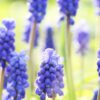
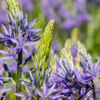
Brent: The Hyacinthoides which are in bloom right now, the Spanish Bluebells are relatively moisture tolerant in the summertime, as are the Leucojum, the summer snowflakes. They can grow right on the edge of a pond and be happy campers. And then the one that’s Native American, there are not many Native American bulbs, but the Camassia, the bulb that [inaudible 13:07], we call her Sacajawea actually kept Lewis and Clark from starving when they were snowed into the Bitterroot Mountains. She went out and dug Camassia bulbs and roasted them and they kept them from starving and enabled them to complete their journey to the Pacific Northwest. Camassia bulbs grow in wet meadows up in the high mountains, so they are also moisture tolerant.
Jay: All right, cool.
Brent: A lot of the summer bulbs are very moisture tolerant simply because they are actively growing in the summer and they don’t mind the wet soil they would much rather have occasional wet than dry.
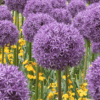
Jay: Okay some great suggestions there as well. I’m noticing that things like Alliums are beginning to come up, but it has been so doggone cool. What season are we in here?
Brent: You know it’s interesting. Some things are triggered by temperature, others are triggered by day length. I think Alliums are more triggered by day length. Typically, people who are having flower shows in the spring would love to force Alliums, but it’s almost impossible to force them because we don’t… I don’t know. They just don’t respond. I think they respond more to day length than they do to heat. They are coming up now. The Alliums this spring have beautiful leaves because the winter wasn’t too harsh for them and they are looking really good. Some are up and some are in bloom in some sheltered spots. Boy, I wish there were some Absolutes, but Alliums are coming, Dutch Iris are coming. I saw some blue on a Dutch Iris out in the cut flower bed out here. I saw blue in the bud. So it’s coming, but typically, they are late spring to very late spring items.

Jay: Speaking of timing, what are some things that people can think about bulbs or certain varieties that they might want to look into to create some sort of sequential bloom time?
Brent: We are in the spring season, so let’s talk about the spring right now.
Jay: Sure.
Brent: For next fall, if you want to have things in bloom mid-April to mid-May, typically in most parts of the country, you are going to be looking at the Alliums. You are going to be looking at the Dichelostemma, the California native that blooms later. You are going to be looking at the [inaudible 16:27], another California native blooming later. You are going to be looking at Camassias. Camassias are not yet in bloom, but they are coming up. And then the Eremurus, the Foxtail lilies are such dramatic, tall, wonderful plants. They and the Alliums are incredible, amongst the best plants for pollinators because they have so many florets and there are so many nectar sites for pollinators to land and…
Jay: A lot of surface space.
Brent: Indeed.
Jay: All right. Let’s see. Another question that came in was, how do you come up with the names of some of your hybrids like Golden Echo?
Brent: It’s often a collective effort. We have a team that helps us evaluate and select ones that are good enough to name. It’s a joint, sort of different people recommend different names and then we try to select the name that best suits the flower. It’s helpful if it’s somewhat descriptive. It’s also helpful if it’s easy to say. It’s also important that it be recognized around the world rather than just here in the United States. Many of these things like our Baby Boomer, they are… A big part of us are baby boomers. Becky and I discovered we weren’t. We were born a year or two early.
Jay: Yeah, a little early.
Brent: So I forgot. What are we, the lost generation or something? I can’t remember the name.
Jay: The lost memory.
Brent: The lost memory. My floppy disk takes a little longer these days. So it’s not lost. It’s retrievable. Anyhow, the names are important. A friend of mine introduced one of the most beautiful daffodils in Holland back in the late 60s and or maybe early 70s. Everybody loves the queen in Holland, but the queen already had one named in her honor, so he named it for her summer home, S-O-E-S-D-I-J-K. Well, the Dutch people all know that’s Soesdijk, but nobody… They couldn’t pronounce it and they wouldn’t buy the bulb. The bulb just faded away. Nobody buys it. Nobody wants to grow it. They can’t make money on it. Kind of crazy.
Jay: So it has got to be something recognizable worldwide.
Brent: That’s right and easy to say and easy to spell and all those things.

Jay: Our last question is, what are ways to keep animals from eating my bulbs and plants?
Brent: You know there are herbivores that make their living eating plants. Some of us are herbivores that eat only plants. I eat a mix, so I’m an omnivore, I guess. There are some animals that are omnivores also, but typically animals are attracted to the fragrance, something that smells good to them like, the smell of crocus bulbs is like nuts. The smell of tulip bulbs is rather sweet. Animals have a much better sense of smell than we do. They locate their food typically by smell. Those that are the most highly sought after by the animals are the crocuses and tulips. And then to a lesser degree, some of the other bulbs, Hyacinths and other things which may even be a little bit critter-resistant because they don’t taste good. Alliums are a little bit critter-resistant because they don’t smell good to the critters.
How do you critter proof your bulbs? There are all kinds of wire cages you can build. You Can put sharp crushed gravel around the bulbs in the hole. But we find the best one is to mask the fragrance of the bulb. Typically, spraying the bulb with the best repellent, the worst smelling repellent you can find and letting it dry on the bulb prior to planting and then the critters don’t smell the sweet smell or nutty smell. They are less apt to dig it up. We like one called Plantskydd- S-K-Y-D-D. It’s a Scandinavian product to begin with. I think it is made in this country now. It has a guarantee for six months on foliage above ground and it has a guarantee or they don’t guarantee it, but I think it lasts for a year on the bulb underground. It has a sticker on it that actually holds it to the bulb.
Rabbits are a big problem. I just noticed the other day they are beginning to work on our lilies. They love lily leaves and so I need to get out and just spray my lilies with Plant Skyyd now and hopefully will keep the rabbits down.
Jay: That’s just masking the scent, is that right or is it also distasteful?
Brent: It tastes bad to them also, and I think because it’s slaughterhouse waste it has somewhat of an essence of death or something. I think that critters just somehow recognize that that smells like potential danger.
Jay: Wow.
Brent: So I’m hoping that’s the case.
Jay: Interesting. Looks like that’s all the questions that we had for today. Brent, we appreciate your time. We should do this… We have to keep doing this more often.
Brent: I enjoy doing it, Jay. I look forward to the next time.
Jay: All right.
Brent: Just let me know.
Jay: All right, will do.
Brent: I’ll be available.
Jay: Thanks, Brent. And thank you for joining us on this latest edition of Tete-a-Tete. You can subscribe to this program by going to Talkshoe.com or podcast on iTunes and searching Brent and Becky’s. Follow us on Facebook, Instagram, Twitter, wherever you are social. Again, just searched for Brent and Becky’s on those platforms. We will let you know when we will be recording another episode. You can leave your questions there and we will answer them on the next show. Thanks again for joining us. Let’s get out there and make the world more beautiful. We will see you next time on Tete-a-Tete.